
Computational Biology and Bioinformatics
The Gorodkin Group is interested in understanding different aspects of molecular structure, regulatory processes, mechanisms and in designing computational tools. The group addresses using biological information from both data processing and algorithmic perspectives in a wide range of contexts.
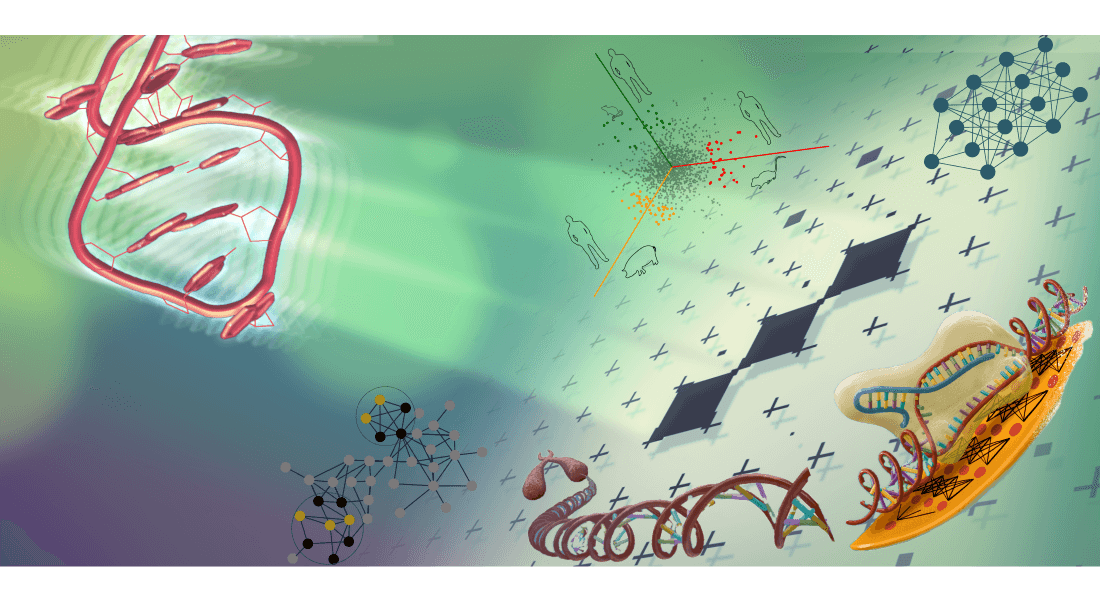
The group has a wide range of interests, including developing algorithms and computational tools, some focused on predicting RNA structure and interactions and others focused on on- and off-target analysis of therapeutic and biotechnology-related molecules such as siRNAs, CRISPR gRNAs, and peptides. Deep learning techniques are used when sufficient data are available. We work on multiple projects, each with a different focus, involving a broad range of organisms, including bacteria, plants, insects, animals, and humans, and we develop pipelines to analyze omics data.
We work with animal models of human disease, for example neuro-related conditions, predicting pesticide side effects, studying host–microbiome interactions, and investigating bacteria used in industrial contexts as cell factories or in relation to CO₂ conversion. More information about the group and further details are available at http://rth.dk.
We are currently involved in a broad range of projects. Several group members work on CRISPR gRNA design using deep learning strategies (https://rth.dk/resources/crispr). Others focus on off-target assessment of siRNA and peptide-based pesticides for plant protection, involving interaction and structural analysis of RNAs and proteins using energy-based methods and deep learning (http://ensafe.dk).
Another project addresses antimicrobial resistance in pigs (https://projects.au.dk/pig-paradigm) by studying host–microbiome interactions using omics data and developing deep learning methods. We also work on RNA 3D structure prediction using a combination of knowledge of molecular folding and machine learning. In addition, we investigate RNA zip codes that determine the localization of RNAs in the soma or dendrites of neurons through RNA structure analysis and deep learning.
The group is involved in an in silico infrastructure project aimed at automated, LLM-based seamless data integration. This project also contributes to the European life sciences infrastructure ELIXIR, and the group leads the Danish node, ELIXIR-Denmark (http://elixir-denmark.org). The projects are funded by the Novo Nordisk Foundation, the European Union, and ELIXIR.

Group members
| Name | Title | Phone | |
|---|---|---|---|
| Anthon, Christian | Systems Administrator | +4521510929 | |
| Demircan, Gül Sude | PhD Fellow | +4535325880 | |
| Doncheva, Nadezhda Tsankova | Special Consultant | +4535332204 | |
| Draghi, Arianna | Postdoc | ||
| Favaro, Lorenzo | PhD Student | +4535327399 | |
| Gorodkin, Jan | Professor | +4523375667 | |
| Havgaard, Jakob Hull | Associate Professor | +4535320139 | |
| Janapa Anilkumar, Neha Jay | Visiting Student | ||
| Liang, Buwen | PhD Fellow | +4535334069 | |
| Mukherjee, Sunandan | Postdoc Marie Curie | +4535330945 | |
| Rehman, Zak | Academic Research Staff | +4593958123 | |
| Seemann, Ernst Stefan | Associate Professor | +4535326776 | |
| Sun, Ying | Research Consultant | ||
| Tran, Nguyen Ngoc Vi | PhD Fellow | +4535331815 | |
| Wilkinson, Leo Max | Research Assistant | +4535323105 | |
| Wolfhagen, Mikkel Frier | PhD Fellow | +4535322817 |