
Social Epidemiology research group
Exploring how social structures and relationships shape health across the life course.
Our research investigates social inequalities in health using register data, surveys, and advanced epidemiological methods to promote public health.
The research group on social epidemiology aims to uncover and understand mechanisms driving social inequality in health. Our research is focused on how social structures, institutions, and relationships influence health. We have particular interest in exploring how socioeconomic factors, gender, family relationships, geographical disparities, and neighborhood effects as well as social and economic policies affect health across the life course.
We have strong methodological expertise in classical epidemiological study designs, natural experiments, and family designs. Through triangulation of different methodological approaches, we strive to identify causal explanations/ pathways of social disparities in health outcomes.
Our work primarily focus on administrative data from the national registers, survey data (e.g. the Women in Healthy Transition Survey, the National Health Profile), and data from nationwide databases (e.g. the Danish Conscription Register, the Danish Twin register, The Danish Adoption register).
The overall aim of our research is to improve public health and promote social equity by generating knowledge about the bidirectional relationships between social factors and health.
The research group is currently working on several projects related to family health, women’s health and psychiatric epidemiology.
Family health projects
Social foreground and health
Epidemiological studies examining intergenerational perspectives on social inequality in health and healthcare use among older adults. Through analyses of intergenerational linked Danish and Swedish register data, we investigate how adult children and their socioeconomic resources impact their parents health, healthcare use and longevity in old age.
Intergenerational educational mobility
Studies examining the impact of individual and family health on intergenerational educational mobility. This project investigates how individual and family health may influence whether children achieve higher education than their parents, using nationwide register data to explore patterns in intergenerational educational mobility
Depression runs in the family
Epidemiological studies about family aggregation of depression. This project investigates how family history of depression and childhood environment influences the risk and timing of developing major depression. Using Danish registry data, we follow individuals from adolescence into adulthood to uncover patterns across generations.
Women’s health
Women in Healthy Transition
Epidemiological studies on how various aspects of social conditions and possibilities as well as health are related to menopause onset and symptoms. In this project, we use nationwide questionnaire data from the KISO survey linked with register-based data.
Psychiatric epidemiology
Diagnostic instability in psychiatry
Epidemiological studies on the Impact of Self-Reported Sleep Quality versus Quantity on Psychiatric Disease. This project explores how self-reported sleep quality and quantity relate differently to psychiatric and somatic disease risk, using Danish health survey and register data to identify high-risk profiles and inform prevention strategies.
Psychiatric epidemiology in a life course perspective
Epidemiological studies predicting dementia using Danish life course register data. This project uses Danish register data to develop models that predict dementia in old age, comparing traditional prediction methods with advanced language-based models that account for the timing and sequence of diagnoses.
Sleepsyc
Epidemiological studies on the Impact of Self-Reported Sleep Quality versus Quantity on Psychiatric Disease. This project explores how self-reported sleep quality and quantity relate differently to psychiatric and somatic disease risk, using Danish health survey and register data to identify high-risk profiles and inform prevention strategies.
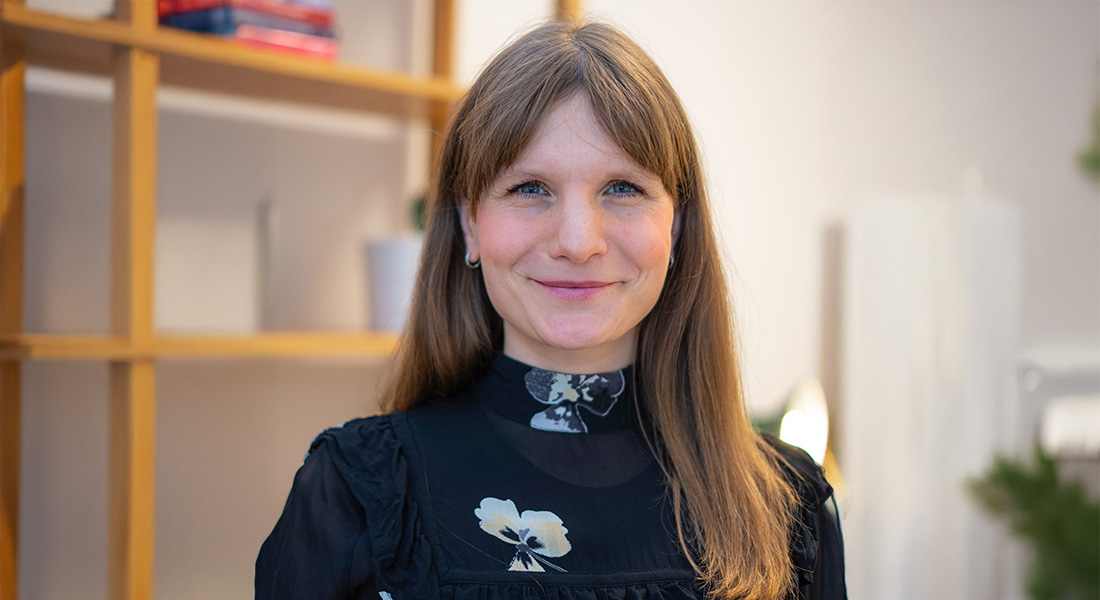
Research group leader
Terese Høj Jørgensen
Associate Professor
Email: tshj@sund.ku.dk
Phone: +4535335886
Forskere
| Name | Title | Phone | |
|---|---|---|---|
| Else Foverskov | Associate Professor | +4535328974 | |
| Kevin Billesborg Pedersen | PhD Fellow | +4535335930 | |
| Marcelo Rene Cardona Cabrera | PhD Fellow | ||
| Mathilde Marie Brünnich Sloth | PhD Fellow | ||
| Sigrid Normann Biener | PhD Fellow | ||
| Terese Høj Jørgensen | Associate Professor | +4535335886 |