
Depression runs in the family
Epidemiological studies on family aggregation of depression.
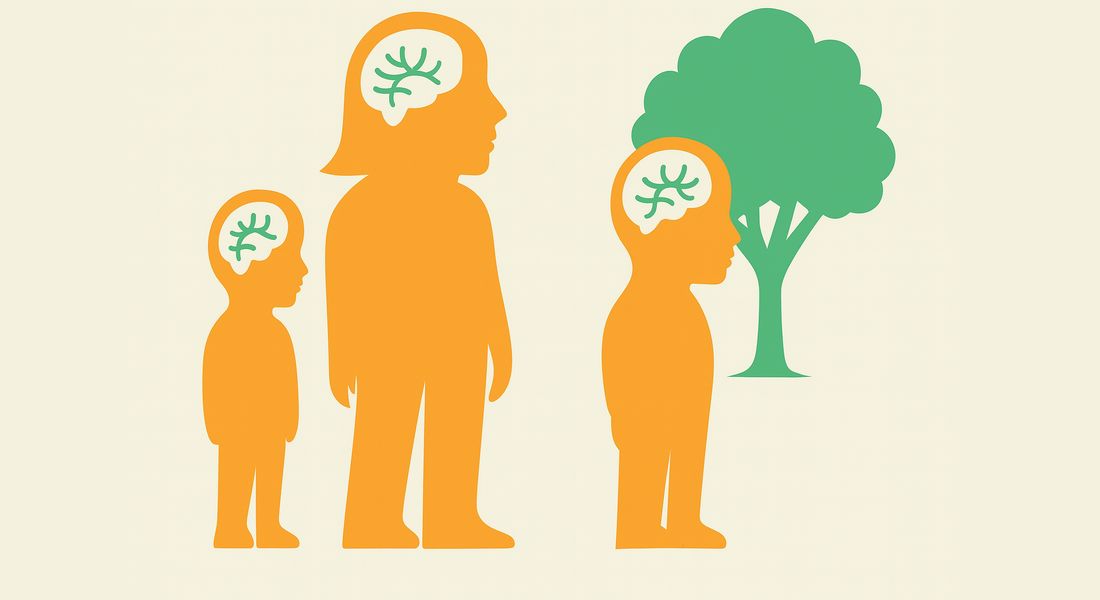
Illustration: Mathilde Marie Brünnich Sloth, 2022
This project investigates how family history of depression and childhood environment influences the risk and timing of developing major depression. Using Danish registry data, we follow individuals from adolescence into adulthood to uncover patterns across generations.
The overall aim of this project is to investigate the importance of family history and childhood environment for the risk of depression and age at onset.
Depression is a common disorder with a lifetime prevalence of approximately 15%. Twin and adoption studies have shown that both genetic and environmental factors play a role in the development of depression. However, it remains unclear how the influence of environmental factors depends on familial predisposition across generations, and whether the significance of familial predisposition varies with age at disease onset. In this project, we utilizes the rich Danish registry data to follow all Danish citizens born from 1960 to 2003 with known parental identity followed up from their 15th birthday until time of major depression, censoring, or end of 2018. The associations will be analyzed using survival models.
We found that maternal, paternal, full sibling, or half-sibling with major depression were associated with 2-fold higher risks of developing major depression among both men and women. The risk increased with the number of affected family members; individuals exposed when 30 years or older had markedly lower risk. Surprisingly, the risk estimates were largely independent of whether it was the person’s mother, father, full sibling, or half-sibling who has been diagnosed with depression.
Looking into the combined exposure of family depression and childhood adversities, we found that family major depression history poses the greatest risk of adult depression, surpassing the risks associated with most childhood adversities, except for being placed in foster care. Individuals with a family history of major depression have a two-fold increased risk of developing major depression, whereas those who experienced at least one childhood adversity face a 1.5-fold increased risk. The risks of developing depression were only marginally higher when both family depression history and childhood adversities were present.
Research group leader
Terese Høj Jørgensen
Associate Professor
Email: tshj@sund.ku.dk
Phone: +4535335886
Funding

Project periode: 2022-2025
Staff
| Name | Work place | |
|---|---|---|
| Terese Sara Høj Jørgensen | tshj@sund.ku.dk | University of Copenhagen |
| Frederikke Hørdam | Center for Clinical Research and Prevention | |
| Merete Osler | merete.osler@regionh.dk | University of Copenhagen |